Mr. Sweeney and Mr. Luster bring decades of industry experience and established professional relationships across the global renewable fuels sector. Their backgrounds include prior and ongoing engagement with a range of recognized technology licensors and service providers that are commonly involved in the development, construction, and operation of renewable fuels projects, including EPC contractors, operations and maintenance providers, insurance and risk advisors, legal counsel, and independent research and chemical analysis firms that support project development, execution, and long-term operations.
Project Overview – Methodology & Data Sources
The information presented in this Project Overview is based on market research and financial analysis derived from publicly available industry sources, third-party publications, and commonly referenced market data. All financial assumptions, projections, and illustrative scenarios are intended to provide a high-level assessment of the potential commercial viability of the project and do not represent final investment metrics or commitments.
Data and assumptions referenced herein reflect current understanding of market conditions, including but not limited to feedstock availability, applicable financial incentives, technology readiness levels, anticipated capital and operating cost ranges, site location considerations, and prevailing offtake market pricing for e-methanol and related low-carbon fuels.
This information is provided for discussion and evaluation purposes only, to support engagement with potential partners, investors, and stakeholders as part of an ongoing development and diligence process. Actual project outcomes may vary based on future market conditions, regulatory developments, technology selection, commercial arrangements, and final engineering.
Final capital costs and financial outcomes are subject to refinement through the FEED engineering process and subsequent commercial agreements.
Port Pascagoula, MS E-Methanol Project
-
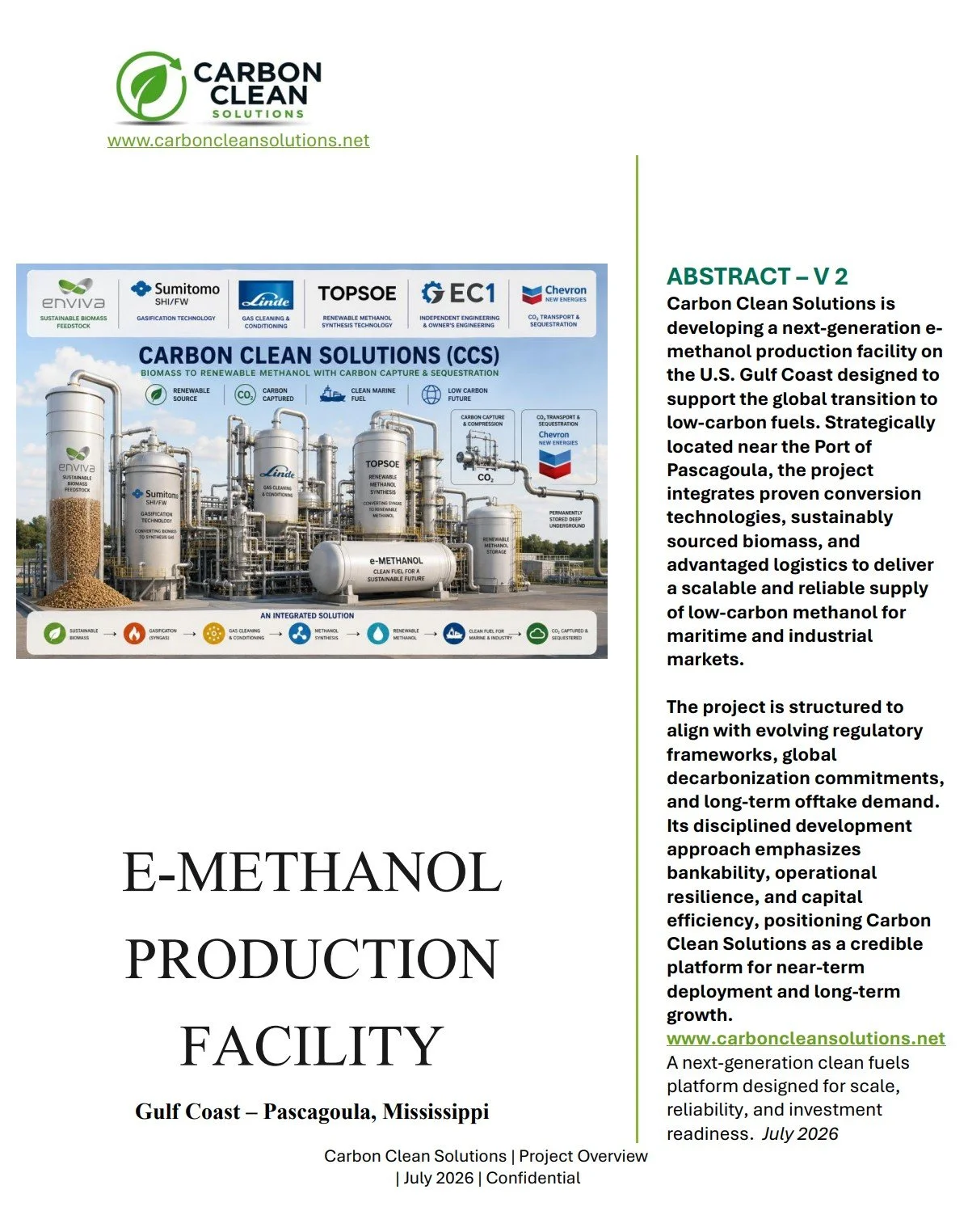
This overview outlines a carbon-negative green / e-methanol production facility located near the Port of Pascagoula, Mississippi – a waterfront , heavy-industrial site with port connectivity and existing industrial infrastructure, utilizing locally sourced wood pellets as renewable feedstock. The project converts biomass into synthesis gas via Sumitomo CHI FW gasification, followed by methanol synthesis using Clariant catalysts.
Mission: Convert sustainably sourced industrial-grade wood pellets into carbon-negative green methanol and related low-carbon products to serve global marine fuel, chemical and industrial decarbonization markets at price points consistent with contracts paid by Maersk and peers.
The facility targets 30–50 million gallons per year (MMgy) of e-methanol (≈ 90,000–150,000 metric tons per annum).
Competitive Advantage: The project benefits from a unique incentive stack, strategic Gulf Coast location, abundant forest waste feedstock, and potential eligibility for hundreds of millions of dollars in tax credits and grants.
-
Demand for Green Methanol
Global push toward decarbonization along with shifting maritime industry transition towards adoption of green fuels is augmenting the global e-methanol industry. The product’s ability to replace fossil-based methanol while reducing lifecycle emissions makes it a strategic choice for governments and corporations aiming to comply with climate commitments.
Shipping companies are increasingly turning to e-methanol to comply with IMO’s emission reduction goals. Its compatibility with existing engines and infrastructure makes it an attractive alternative to LNG and heavy fuel oil, thereby adding to market growth. For instance, in July 2025, Taiwan based, Yang Ming Marine Transport Corp expanded its methanol-ready fleet by ordering six new containerships.
Shipping industry transitioning to methanol-burning vessels (Maersk, CMA-CGM, COSCO)
Green methanol demand projected to grow from 0.2M tons (2024) → 15–20M tons by 2035
Global supply gap expected: 10M+ tons annually
Why the Gulf Coast
Largest U.S. petrochemical corridor
Deep-water ports for global export
Growing hydrogen & CCS infrastructure
Proximity to massive Southeastern forest biomass resources
Strong state/local support for clean energy manufacturing
Location Advantages – Pascagoula, Mississippi
Deep-water port with break-bulk & bulk handling
Established forest products supply chain
Proximity to Gulf shipping lanes
Competitive labor, land, and utilities
State and local support for advanced manufacturing & clean fuels
-
The competitive landscape of the e-methanol market is characterized by a mix of established energy giants, emerging clean tech firms, and strategic partnerships across the hydrogen and carbon capture value chains. Companies involved in green hydrogen production, CO₂ sourcing, and methanol synthesis are forming integrated business models to gain early-mover advantages. Major players are investing in pilot projects, scaling up production capacities, and securing long-term offtake agreements, particularly in maritime and industrial sectors. The top 5 companies in the E-methanol industry including BASF, Liquid Wind, Europe Energy, Methanex, and ABEL Energy held maximum market share in the year 2024.
Competitive Landscape (Gulf Coast Projects)
Ørsted / Maersk (TX)
SunGas / C2X (LA)
Lake Charles Methanol (LA)
Nacero / Texas Gulf Coast
Bia Energy / Shreveport (LA)
Combined annual production total = 6,850,000 t/yr (≈6.85 Mt/yr).
None of these projects are yet operational, leaving a temporary supply vacuum our project can enter early.
Key takeaways for investors
Strategic significance:6.85 Mt/yr is small relative to all global methanol today, but large in the renewable methanol context — these plants could command premium prices and long-term offtake agreements. “Methanex+1”
Market timing matters: Announced renewable capacity by 2030 is big on paper (tens of Mt), but many projects are pre-FID/FEED — execution risk means early movers with reliable feedstock/offtake and incentives can capture outsized value. “Bioenergy International”
Offtake opportunities: Marine bunkering hubs and shipping lines are early large buyers — even a few Mt/yr can support important commercial relationships (and premium pricing) while the rest of the market catches up. “Reuters+”
-
Deep-water port with break-bulk & bulk handling
Established forest products supply chain
Proximity to the Chevron Pascagoula Refinery Carbon Capture and Storage (CCS) project. Pascagoula CCS could safely capture and store CO2 from the Refinery with ambitions to expand to other industries in the area looking to lower their carbon emissions in the future.
Proximity to Gulf shipping lanes
Competitive labor, land, and utilities
State and local support for advanced manufacturing & clean fuels
-
Process Overview-estimates to be verified through FEED
Wood Pellet Supply
700,000 up to 1.5 Mtons/year (sustainably sourced) Final annual volume will based on EPC FEED optimization recommendations.
Gasification
Oxygen-blown biomass gasifier by Sumitomo CHI FW
Gas Cleanup & Conditioning
Tar reforming, sulfur removal, syngas adjustment
Methanol Synthesis
Clariant catalyst systems
Product Storage & Export
Marine loading and/or rail/truck distribution
Capacity
30–50 MMgy
90,000–150,000 tpa methanol
Carbon Intensity (CI)
With CCS and woody biomass: CI score can be negative (-20 to -80 gCO₂e/MJ)
Optional carbon capture → carbon-negative profile
Qualifies for highest-value federal credits under 45Z and 45Q
Optional additional product lines:
Green hydrogen
Bio-CO₂
Biochar
Bio-oil
-
The regulatory landscape of the e-methanol market is rapidly evolving, shaped by global decarbonization goals and region-specific climate policies. In Europe, directives like RED III and FuelEU Maritime mandate renewable fuel quotas and emissions reductions, directly incentivizing e-methanol adoption in transport and shipping. North America supports the market through mechanisms such as the Inflation Reduction Act’s 45V tax credit for clean hydrogen and California’s Low Carbon Fuel Standard, which recognizes electrofuels like e-methanol.
In Asia-Pacific, countries like China, Japan, and South Korea are integrating e-methanol into national energy strategies, backed by innovation funds and cross-border certification systems. Emerging markets such as Chile, Morocco, and India are aligning with international standards and offering subsidies to scale production, positioning themselves as future exporters under frameworks like the EU’s guarantees of origin.
Federal Incentives
Incentive Estimated Value
45Z Clean Fuel Production Credit $25–$80M/yr
45Q Carbon Capture Credit $10–$40M/yr
DOE Bioenergy Grants (BETO) $5–$50M
USDA BCAP Biomass Support $10–$14M/yr
BCAP Value=Tonnage Delivered×$20/dry ton for up to two years of
deliveries for eligible materials.
Advanced Energy Manufacturing Credit Additional eligible
Mississippi State Incentives
Program Benefit
MFLEX Offsets income, franchise, sales/use, & withholding taxes
Clean Energy Initiative 10-year income & franchise tax exemption
Sales/Use Tax Exemption For construction & equipment
Workforce Training Funds $1,500–$4,000 per worker
California State Incentives
Program Benefit
California Collateral Funding Program CalCAP provides a risk management tool to a participating financial institution (PFI) after a small business borrower (SBB) has applied to a PFI, and the PFI has begun the underwriting process. $20M is the maximum loan size.
Port Pascagoula / Jackson County Incentives
Incentive Value
10-Year Property Tax Abatement Multi-million reduction
Freeport Inventory Exemption Zero tax on exported stock
Port improvements support Negotiated
Utility infrastructure incentives Case-by-case
📌 Total Potential Incentive Value: $150M–$400M+
(over 10 years not including BCAP Value of $20–$28M over two years, or the CalCAP)
-
Core Assumptions
CAPEX:$400 million (all-in EPC + contingency)
Production: 90,000 / 120,000 / 150,000 tpa
Methanol pricing:
Low: $1,150 / t
Base: $1,300 / t
Best: $1,500 / t
OPEX: $115–140 million/year (scale-adjusted)
Project life: 20+ years
Model Type: Steady-state, unlevered, illustrative
Gross Revenue
Case Production (tpa) Price ($/t) Annual Revenue ($MM)
Low 90,000 1,150 103.5
Base 120,000 1,300 156.0
Best 150,000 1,500 225.0
Operating Cost Assumptions
Case OPEX ($MM/year) Notes
Low ~115 Lower throughput
Base ~125 Nominal steady state
Best ~140 Higher feedstock & utilities
EBITDA (No Incentives)
Case Revenue ($MM) OPEX ($MM) EBITDA ($MM) EBITDA Margin
Low 103.5 115 (11.5) Negative
Base 156.0 125 31.0 ~20%
Best 225.0 140 85.0 ~38%
This pricing reset intentionally demonstrates why incentives and contracted offtake are critical to downside protection.
Incentive Stack Impact (Illustrative)
45Z Clean Fuel Production Credit
Estimated benefit: $30–75MM/year, depending on output and CI score
45Q Carbon Capture Credit (Optional)
Estimated benefit: $34–51MM/year
CCS capex excluded from base
BCAP (Feedstock-Linked, Early Years Only)
$10–14MM/year (first two years, if applicable)
EBITDA With Incentives Applied
Base Case (120,000 tpa @ $1,300/t)
Scenario EBITDA ($MM)
No Incentives 31
+ 45Z (Low) ~65
+ 45Z (Mid) ~85
+ 45Z (High) ~105
+ 45Z + 45Q 135–155
Best Case (150,000 tpa @ $1,500/t)
Scenario EBITDA ($MM)
No Incentives 85
+ 45Z 130–160
+ 45Z + 45Q 170–210
Indicative Unlevered Project Returns
Metric Low Base Base + Incentives Best +Incentives
EBITDA Margin N/A ~20% ~50–60% ~65–70%
Simple ROI Negative ~8% ~20–25% 30%+
Project IRR <8% ~11–13% ~20–24% 26–30%
Payback N/A ~9–10 yrs ~5–6 yrs ~4 yrs
Key Takeaways
Unincentivized downside is clearly visible, which lenders expect to see
45Z is critical to achieving infrastructure-grade returns at $1,300/t
Best-case pricing + incentives produces top-quartile IRRs
Project economics remain robust and financeable with:
Contracted offtake
Incentive qualification
Disciplined EPC execution
-
Pre-Development & Site Control 6 Months
FEED Engineering 9-12 Months
Permitting & Incentives Parallel (12–18 months)
Final Investment Decision Month 18–24
EPC & Construction 24–30 months
Commissioning & Ramp-up 6 months
Commercial Operations ~4.5–5 years from start
-
Risk Mitigation
Feedstock Regional pellet oversupply
Methanol Price Long-term offtake floors
Policy Base case works without incentives
Debt Coverage DSCR >1.4x in Base Case
Capital intensity Incentive stacking + federal credit monetization
Technology Proven commercial scale references with Corporate Guarantees
-
Capital Requirement: $15–25 million
Use of Funds
FEED Engineering
Phase 1 site preparation & interconnects
Environmental & air permits
Grant and incentive applications
Commercial offtake development
Owner’s engineering & project management
Outcome
Fully de-risked project ready for FID
Clear incentive stack and contracted revenue base
-
This Pascagoula-based e-methanol project is positioned to become one of the first commercial-scale, carbon-negative methanol plants in the United States, benefiting from:
Abundant sustainable biomass
Proven industrial technology partners
Strong maritime offtake demand
Attractive unlevered returns with incentive upside
This project represents a high-growth, tax-advantaged, globally scalable clean-energy investment opportunity.
Recommendation: Proceed with pre-development capitalization, advance FEED and offtake discussions, and position the project for FID within 24 months.